• Home
  • About
  • The Fabulous Fifties
  • Gastronomical Delights
  • Entertainment in the Non-Digital Age
  • Memory Keeping
  • Sporting Adventures

growingupstrange

~ The Fifties-A Simpler Time

growingupstrange

Monthly Archives: September 2012

Line Dried Laundry

28 Friday Sep 2012

Posted by S. A. Strange in The Fabulous Fifties

≈ 1 Comment

On this particularly beautiful September morning, the temperature is in the sixties and the wind is blowing slightly through the foliage, still green, but soon to be varietals of colors and more than just picturesque. On a day such as this, I feel that man should never have invented the dryer. My apologies to George T. Sampson, who invented the first clothes dryer in the late 1800s.

Even though the now familiar electric clothes dryer was invented in 1915, the Strange family didn’t own a clothes dryer until the late fifties. Instead, Mother transported the wet laundry from the washing machine to the backyard to hang on the clothesline that stretched across the expanse of the lawn. Some of our neighbors owned the metallic rotary clothesline that resembled a large beach umbrella with internal lines designed like a spider web. The contraption spun around which made it easier to pull the clothes from the lines when they were dry. Most people merely had multiple lines of rope stretched horizontally between two posts sectioned off, away from the house, and in the sun.  For us, a simple rope extended between two trees sufficed.

The Strange laundry was usually done in the morning, so there would be an entire day for the clothes to line dry. With the wind blowing and the sun shining, Mother ventured out to the clothes lines with basket and clothespins bag in hand. The clothespins were wooden and either made out of one long strip of wood with a split up the middle, or  two pieces of wood held together by a metal spring. The two styles were mixed in together and it didn’t make any difference whether they matched or not. Their job was to hold the clothes securely on the line regardless of the amount of wind that might whip through the air on any given day.

One of the trees holding up the clothesline was a large Weeping Willow standing almost exactly in the middle of the back yard. In the spring, a very ornery pair of Blue Jays arrived and nested in the Willow. The birds went about their business of creating their nest and at first made no ruckus during their construction project. That is, until the eggs hatched, and then, depending on the incubation stage of the eggs, the Jays  entire demeanor changed.

Mother would nonchalantly begin her task of hanging out the laundry and here came the Blue Jays. They swooped down  on her, almost in an attack-like mode and squawked voraciously at her as though she were intruding on their nest. Apparently the nest, the tree and most of the backyard became part of their territory. Trespassing anywhere near their claimed stake was verboten.

Mother was barely able to get the laundry pinned up as they repeatedly attacked her. When everything was dry, all of us would run out to the clothesline and quickly pull the clothes and sheets and towels from the line, dropping them into the basket. The clothespins spilled on the ground all around us and later in the day Mother retrieved them from the ground when the Blue Jays were quiet and not in view. Their protective behavior generally lasted a few weeks and once the baby birds were born the adult Jays settled down and didn’t bother Mother after that-at least not as much.

Once dry, Mother sprinkled the cotton laundry, folded the pieces and placed them in a pillowcase in the refrigerator. Once cooled, she brought out the clothes and ironed them. There were no permanent press clothes so many garments required ironing. Once folded or placed on hangers, the clothes were put away in their respective drawers and closets-waiting for their next adventure with the Blue Jays.

Other than the excitement of the attacking birds, doing laundry was I suspect, a tedious and boring chore. But the image of the cotton sheets blowing in the wind, with the fresh air engulfing the fabric and the ultimate pleasure of breathing in the outdoors as a cotton undershirt was slipped over my head, is a childhood memory that brings pleasure to my senses.

Once we bought a clothes dryer, the line dried laundry went by the wayside. The Blue Jays moved on and eventually the Weeping Willow died and had to be cut down.  I don’t remember exactly when that happened, but on a day such as this, I can still see the laundry hanging on the clothesline, blowing in the wind. Mother is still ducking the attacks of those loquacious Blue Jays and the sun is shining through the weeping limbs of the Willow.

I like to sleep on freshly laundered, fully cotton, ironed sheets that smell crisp and clean. I know that they have not been dried by the sun and the breeze, but I like to imagine that they have. And perhaps as humanity looks to ways in which to reduce global warming, the clothesline will come back out, clothespins will make a resurgence and the Blue Jays and other birds will once again stake out their rightful claim to backyards across the world.
Jarred in Indiana

26 Wednesday Sep 2012

Posted by S. A. Strange in Entertainment in the Non-Digital Age

≈ Leave a comment

Tags

jarred bugs, Lightning bugs, Woodmere Asylum

We weren’t cruel and inhumane-we were curious children of the fifties looking for entertainment  on warm, humid summer nights right before the sun went down in the waning dusk of the day. Most nights we hunted for lightning bugs illuminated in all their wonder as they flew across the invisible borders between houses crisscrossing from front to back as we chased them mercilessly. We caught them in our hands and carefully placed them in glass jars for safe (??) keeping. We held magic and wonder in our hands as we watched the intermittent twinkling light that leaked between our tightly closed fingers.

But before the chase, our first challenge was finding jars with matching lids. Mother was anything but organized, and we often searched the discarded trash, the kitchen cabinets and under the sink to find a jar. When that search revealed no finds we looked in the refrigerator for that jar of jelly or mayonnaise that was nearly empty. We tried not to get caught taking jars out of the refrigerator, but we were probably not as successful at that chicanery as we thought.  The lingering smell of mayonnaise in a recently washed out jar was a telltale sign that we had pilfered a jar still containing food. The smell was probably a bit of a put off for the captured creatures as well, but we did not care what lightning bugs thought, and besides, they might even have liked their odoriferous prison!

After finding just the right jar, we punched holes in the metal lid. We, meaning Daddy. He was the keeper of the knives and other sharp instruments so he was the one who  carefully positioned the knife on the lid, placing the palm of his hand on the top of the knife handle and pounded one hand with the other. He usually punched four or five holes in the lid, which generally allowed enough oxygen to enter the glass-enclosed space to keep the bugs alive. Then, we were ready to hunt.

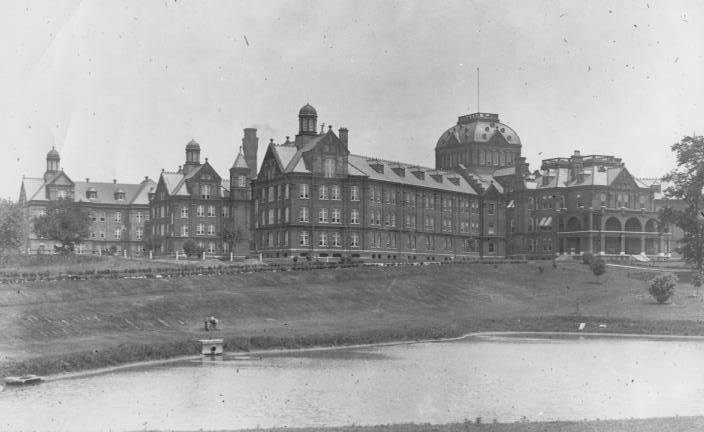
It wasn’t difficult to track or trap the bugs because there was an abundant supply on those summer nights. After sunset, they swarmed our back yard, which was adjacent to the forbidden cornfields-property of the local state mental hospital. Oh, I forgot to mention. Our property backed up to the state mental hospital-referred to as Woodmere Asylum in the old days. Definitely more about that later.

We ran through the neighbors’ front and back yards with our small hands poised to capture the bugs as they lit our way through the darkness. Our child’s play was about competition in the end, as we always wanted to know who caught the most bugs.  Sometimes the competition was just between Sissy and me and at other times, there was a crowd of kids running through the neighborhood. Three girls lived two doors down, another two girls and a boy lived further down the street, and five boys lived right next door. With all of us involved in the sport, the cacophony of noise we created, punctuated the darkness which surrounded us on our search.

Once we captured the bugs, there was little left to do. We watched the creatures “turn on-turn off” in their temporary homes and when we tired of the light show, we released them into the night. We never considered the physical or psychological harm imposed on our captives, and we considered the adventure humane, because in the end, we always gave them their freedom. It was an early version of catch and release.

Woodmere Asylum

As they flew from their glass prisons, the twinkling lights moved into the distance. They floated above the flowers and vegetables of the garden like crown jewels, and moved quickly away from our property disappearing into the forbidden cornfields. It was a fantastical adventure. In our uneducated knowledge of lightning bugs, we imagined that perhaps their minds altered during captivity and they traveled through those cornfields and into the world of the almost forgotten inmates of the asylum, joining them in their fantasies and hallucinations. Childish thoughts or imaginations gone wild.  We’ll never know. The lightning bugs carried their secrets with them as they joined the other captives who were jarred in Indiana.

Lies and Lessons

25 Tuesday Sep 2012

Posted by S. A. Strange in Memory Keeping

≈ Leave a comment

Tags

Safety in the water

Mother didn’t know how to swim. When we went swimming on family night at the Eastside Park swimming pool, she never ventured past the three-foot depth marker, preferring to watch us swim into the deeper water holding onto Daddy’s neck and shoulders, lying against his back. The public pool offered free-swimming lessons beginning in June and Mother wanted to take advantage of the offering. She understood the importance of being able to swim, and she didn’t hesitate to do anything that ensured our safety in and out of a body of water. There was one small problem-a child had to be five years old to take swimming lessons and I am a Leo. My birthday is August 10 and I was only four at the beginning of the summer of 1955. My sister, Georgia, was already six and Mother didn’t want her to miss another summer without swimming lessons.

Today of course, we throw babies in the pool very early, hoping to instill a familiarity with water at an early age; no age requirements in place. Nevertheless, in the fifties, rules were rules and according to the rules, if a child wasn’t five by June, that child couldn’t participate in the free lessons at the public pool.

Mother was apparently determined and I imagine carefully laid out her plan. No birth certificate was required; a verbal statement was sufficient proof of age. Besides, who lies about this sort of thing? Surely not a mother.

The out building stood at the top of the concrete steps marking the entrance into the pool. My sister and I stood on those steps wearing our bathing suits and flip-flops, and holding our towels and bathing caps. We stood anxiously with the rest of the crowd waiting for the dark green shuttered doors to open for business. Mother stood between us holding our hands. As the doors opened, Mother leaned down and whispered in my ear, “When they ask you how old you are, you say five. Your birthday is in April and you are five. Remember, you are five. And, when I tell them how old you are, don’t say anything when I say you are five.”

We patiently waited in line for our turn. As the crowd moved forward, the swimming instructors greeted us as we went entered the building and lined up to register for our free lessons. There were no computer databases to check, no forms to fill out, just a mother’s word; the swearing-in of her births. I vaguely remember all the details of the event, but I clearly remember that when I was asked, “How old are you?” I looked up and said, “I’m five.” I am certain Mother’s heart was racing and a secret smile crossed her face. She directed us forward and left us at that point as we walked toward the locker room to shower before getting into the pool. We showered, walked outside and separated, as we split up into the designated age groups-one for the five years olds and the other for those older.

Mother reappeared outside the chain link fence and pressed her face closely up against the metal fence watching us intently for the next hour until the end of the lesson. I remember the crisscrossed lines that marked her forehead as she proudly and anxiously watched her precious cargo in the water.

This was the only time in my life that Mother asked me to lie. In fact, at all other times, she forbade it. She surely had her reasons that day and whether it was out of necessity or just a need to make her children safe, for my part, I will never know.

I am not a great swimmer, but I love to swim. I love the coolness of the water on my heated body and I love to glide through the water pushing the water away from me as I head toward the end of the pool. My own children began swimming as infants. My daughter was on a summer swimming league for 14 years from the age of four.  I spent many Thursday nights in the summer encouraging her to swim her best and beat her competition in races across a 50-meter pool. I loved to watch her glide effortlessly across the water. She earned a drawer full of ribbons and a box full of trophies to prove that she swam, and swam well. I know that Mother would have liked to watch her swim and would have been very proud of her aquatic feats.

Those green shuttered doors at the Eastside public pool opened for two little girls and a young mother over fifty years ago.  While the three of them waited patiently for the doors to open, I can only imagine that my mother hoped she wasn’t making a mistake in asking her child to lie. Now as I think about that transgression, I can safely say that the little white lie was well worth the risk. I never regretted my part in the deception, and I know that as I propel myself through water, both safely and confidently, had it been me, I would have done the same.


A Whole Lotta Shakin’ Goin’ On

22 Saturday Sep 2012

Posted by S. A. Strange in The Fabulous Fifties

≈ 2 Comments

Tags

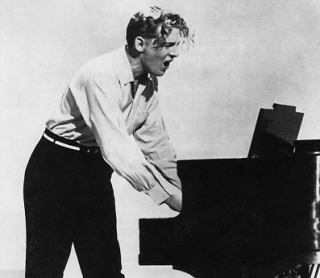
Jerry Lee Lewis AKA The Killer

Music has always been part of my life. Not the melodious tones of a mother singing lullabies or children’s songs-oh, no-Mother couldn’t carry a tune-but the popular, upbeat rhythms of the fifties, as well as the traditional gospel songs performed in churches across the country. Rock of Ages as well as Rock ‘n Roll were part of my musical education.

Because my parents loved to dance, we owned most of the popular 45s of the day and it wasn’t unusual to come home after school and watch Dick Clark’s American Bandstand on the black and white TV, while Mother ironed. I remember lying on the bed in my parent’s bedroom watching the show with my mother positioned just at the edge of my peripheral vision, ironing the clothes and tapping her toes. In addition to the newest stars being showcased on Bandstand, we listened to Buddy Holly, the Ames Brothers, Peggy Lee, Frank Sinatra, Dion and as always, the King-Elvis, himself. The night Elvis was on the Ed Sullivan Show, the four of us-Mother, Daddy, Sissy and me gathered around the television set and watched history being made. While some parents, I am certain, shielded their children from the gyrations of the boy from Memphis, my parents were teaching us how to Shake, Rattle and Roll.


Along with Elvis, was the ever controversial Jerry Lee Lewis, whose rising star catapulted after his appearance of the Steve Allen Show in 1957. Sometime in that same period and after the introduction of his signature song, Great Balls of Fire, Jerry Lee Lewis performed in our southern Indiana town of Evansville at the Armory.

Alice and Festus, a young couple from Tennessee who lived across the street from us, knew Jerry Lee and invited the four of us to the concert.  It was my very first concert, and although I knew little about him, Mother and Daddy were very excited for the opportunity to see “The Killer” live, and on stage.

At the concert, while we watched from wooden folding chairs in our front row seats, Jerry Lee mesmerized the crowd with his talent, his connection to the audience and  his wild and fierce banging of the piano keys. His red, curly hair wrapped around his face and when he pushed back his piano bench to play Great Balls of Fire, the audience went wild.

Unlike some memories, I remember his performance quite vividly, but more importantly, I remember when we went back stage to meet “The Killer” in person. Introduced by our neighbors, Jerry Lee leaned down and held out his hand to Sissy and me and said what a pleasure it was to meet us.  We weren’t fully in tune with his bad boy celebrity status, but the occasion certainly felt momentous and important to two little girls. And, from that point on there was always a Whole Lotta Shakin’ Goin’ On in the Strange house. Care to dance?

Military Time

21 Friday Sep 2012

Posted by S. A. Strange in Memory Keeping

≈ Leave a comment

Tags

Courage, Honor, Military, Paratrooper, Veteran, Veteran's Day, WWII

I learned the lesson of “Put your best foot forward” very early in life. As a child of a WWII veteran, who served his country bravely and proudly, I understood the importance of literally putting my best foot forward, front and center, polished and shined. No pair of shoes in our house went unpolished for very long.  It didn’t matter if the shoes were old or new, they received a spit and polish on a regular basis. Usually on a Sunday night, Daddy carefully lined up all the shoes on the floor as he set out to do his duty.  At the end of his task, every shoe could have passed the scrutiny of any officer, in any branch of the military. He had his shoeshine kit, which was nothing more than an old shoebox filled with the necessary equipment, stored and ready for use.  The easily recognizable Kiwi shoe polish in its circular tin of dark and bronze colors for both black and brown shoes was the mainstay of his kit. There was also the liquid version of Kiwi white polish for those two small pairs of my sister and my white summer shoes or the baby shoes for the toddler who was taking first steps. Vaseline was on hand for any patent leather shoes, a multitude of old socks, and brushes completed the array. White cotton socks abandoned somehow in the washer, dryer, or one, which sported a hole in the toe or heel often, ended up in Daddy’s shoebox.

He used one of the discarded socks, which he placed over one hand to spread the polish, and then slipped his bare hand into the shoe just like a foot, entering the open space inside. He religiously pressed his sock-covered fingers into the semi-soft polish and worked his magic. After he applied polish of varying colors to all of the shoes, he waited for five or ten minutes so the polish could sink into the leather. Then he started back at the front of the line to begin the shining process.  He used another sock, the polishing sock, to release the dullness of the polish and transform the leather to its new life of luster. His hand moved rapidly back and forth against the top, the sides, the heel and the tips of the shoes, leaving one newly shined area to tackle the next polish-laden part of the shoe. He continued his work until he was satisfied with the product, carefully laying the shoe back in its place, which resided quietly next to its partner. When all of the shoes were polished, he instructed us to come get them to put them away. As we picked up our shoes, he cautioned us to place our hands inside the shoes as we picked them up and not to touch the leather “just yet.”

That simple ritual of my childhood remains with me today. I have my own shoeshine kit, with the proverbial Kiwi polish of black, brown, navy and red. Vaseline and unmatched, abandoned socks are part of that kit, as those occupants await their duty, in their designated spot in my closet. Boots, high heels, flats and loafers. I hate to admit how many pairs of shoes I own, knowing that the number is greater than my mother or father ever owned in their lives. But, what I can tell you is that those shoes and boots are neatly stacked, in their boxes, on the shelves, inside my closet. Not one pair is scuffed or dull. In this and in many other ways, I learned to put my best foot forward, always. And, my shoes and I know that a man of honor, courage and duty is responsible for that gift.

Popsicles, Puddings and Pies

19 Wednesday Sep 2012

Posted by S. A. Strange in Gastronomical Delights

≈ Leave a comment

Tags

The Fifties Sweet Tooth

My sister and I have a mouthful of silver amalgams! Even though flouridated water arrived in the early fifties, it wasn’t until Proctor and Gambol launched its Crest with Flouristan that the positive effects of fluoridation on tooth decay were realized. By then it was too late. Kool-Aid was our drink of choice. It only cost 5 cents a pack and cost much less than the colas on the market. Just a cup “or two” of sugar mixed in with the granulated flavored mix and water, and we were ready to drink or lick-licking the popsicles we made with Kool-Aid, that is.

We first poured the sugary liquid into ice-cube trays to freeze. Those frozen delights  gave us much-needed relief on hot summer days, and when the ice cream man rode by on his bicycle powered ice cream wagon, it was not quite so painful to not have fifteen cents to buy the real Popsicle. We knew we had our very own version waiting for us in the freezer. Once frozen, we’d crack the metal handle of the ice-cube tray to release the cubes of frozen sugar, and then wrapped them in a paper towel or napkin to lick quickly, before they melted.

But home-made popsicles weren’t the only sugary treat that contributed to our cavities. Puddings and cream pies made especially for the Strange kids, by none other than Mother, were included in our gastronomical delights. Mother made the best cream pies-ever. Unlike the pies of today, she made the crust from lard-yes, I said lard. Not healthy, but flaky, rich and delectable. Even more inviting were the cream fillings. Chocolate, banana cream, coconut cream, butterscotch or lemon-all topped off with golden brown meringue. Or in some cases-slightly burned-depending on whether Mother was paying attention to the broiler or not. Nevertheless, each pie was a masterpiece.

Our treat, before the pie was done, was licking the spoon or the pot which contained the leftover cream.  One of us got the spoon, and one of us got the pot. The pot was the top prize just by virtue of the quantity of leftover cream. And, while we finished off the remnants of the cream, Mother busied herself with the meringue. Depending on whether she had an operating electric mixer at the time or not-which was not always the case-she sometimes beat the meringue by hand. Do you know how long it takes to beat egg whites by hand?

After much beating, when the meringue was ready (measured by whether or not it stood in peaks), Mother spread the stiff egg whites over the cream and immediately placed the pie under the broiler. With the oven door slightly ajar, the three of us watched the peaks of the meringue quickly brown. We had to be diligent in our watch because in a matter of seconds the meringue could turn from slightly browned to completely burned. And sometimes it did.

Regardless of the meringue’s final condition, the pies were always delectable. And if the cream was still warm when eaten, it was even better. Banana pudding was also best when eaten warm. Another favorite treat and a typical dessert of the fifties.

On occasion, I have tried to replicate Mother’s cream pies, but the crust is never quite as good and the cream not as rich. She never used a recipe or a cookbook, so I have nothing to use as a reference. What I do know is that a cream pie must be enjoyed warm. It cannot be cold. It must not be chilled. For me, the essence of those pies was the warmth of the cream on my tongue. The essence of the experience was the memory that melts my heart. And the silver amalgams?-well, they’ve just been replaced by crowns. And I still use Crest toothpaste.

My Fred Astaire

17 Monday Sep 2012

Posted by S. A. Strange in Memory Keeping

≈ Leave a comment

I am still searching for a man who can dance as well as my father.

My biggest regret is that when I got married, my family didn’t have enough money to have music at my wedding and I was not able to have that father-daughter dance with Daddy. He loved to dance and genetically passed that on to me.

As children, we were always surrounded with music. The small portable record player or the larger console with the hidden record player held the passageway to our musical education.  Mother had no rhythm at all, but on the dance floor, Daddy’s prowess somehow made her appear to have some degree of talent.

On special occasions we would often find them dancing together in our living room as we watched on the edges of the couch waiting for our turns. The four of us would swing about in that small space and alternate partners-the two of us dancing together or dancing with one of our parents. My favorite partner was Daddy. He taught me how to swing and two step, cha-cha and twist. He was always a gentleman on the dance floor as with everything he did. Patient and kind. We recorded our dancing adventures on a 35mm camera and I have repeatedly watched him swing us around graciously on that ancient celluloid with awe and pleasure.

The bluesy sounds of Elvis or the rhythmic beat of the Teddy Bears, he was my very own Fred Astaire. I have this picture of him dancing with my older sister at my brother’s wedding. He has his arms carefully placed on her shoulder and in her hand as she bends her red curly head to watch her feet, making sure she does the right step.  He is looking out across the room, smiling and confident. The dance of his life will always be the dance of my life. I always hold close to me the memories of those evening dances in our living room, twirling around in petticoats and velvet.

I am still searching for a man who can dance as well as my father.

Off to the Races

15 Saturday Sep 2012

Posted by S. A. Strange in Sporting Adventures

≈ Leave a comment

Tags

Kentucky Derby; off to the races; 2 dollar bet; running of the roses

You can’t live on the Ohio River between Kentucky and Indiana, having been born in Kentucky, and not know about horse racing.  The genes for loving horses, the racetrack and the two dollar bill were in our genetic makeup and deeply entrenched in our blood. Evansville, Indiana was only about twenty minutes from Henderson, Kentucky where Ellis Park, built in 1922, was located.

The thoroughbred-racing season began in July and ran through Labor Day during the hottest part of the year. Steam rose off the cornfields as we drove the back roads to Ellis, which were normally nothing more than dirt tracks.  At any other time of the year, the farmer, sitting atop his tractor, was the only traveler on those dirt roads. Lined on each side by flooded or dry riverbanks, this route was quicker than the traffic laden Hwy 41, which was the main route to the track.  From the back roads, we pulled onto the temporary parking lot of green, grassy areas, and Daddy squeezed our car into any conceivable space available. We walked the long way to the track, through dried, river bottom sand. The wind picked up the dust mingled with sand and circled us as we stopped along the way to watch the horses coming out of the stables. The horses were beautiful and the brightly colored attire of the jockeys was stunning even in this smaller racetrack venue.

As children, we didn’t know that the horses weren’t necessarily Derby bound; we just knew that other kids our age didn’t get to go to the racetrack except for our cousins who lived on the Kentucky side of the Ohio River.

At the track, our job was to pick a horse for each race. We made our selections, not by the talent of the horse or the skill of the jockey, but usually by the name of the horse-the name that just might bring us luck. With our two dollar bills tucked away in small pockets or hands, we happily followed our parents toward the grandstand where we leaned on the rails and watched our pick on its way to a hopeful victory.  While some people may have thought taking two young children to the racetrack was inappropriate, I prefer to think of it as another form of education. The experience introduced us to ratios, returns and chance. If you bet two dollars and your horse won, and it paid 2:1, you knew you were going to win four dollars. And if your horse, didn’t win, then you had two less dollars to spend. What a better way to practice basic math!

There was also the mystery of it all. How did you really know which horse was going to win? Mother certainly didn’t, but somehow, she usually came home with at least one winning ticket. She would bet on a horse if it had one of our names, or if she liked the jockey, or if she liked the color of the horse. If the horse was gray, she would always bet on that horse. Even if it had the worst odds of winning. She would bet on that horse.

As an adult, trips to the track continued with my own children in tow, and Mother was still betting on that gray horse. We cheered for her off-the-wall choice, and then stunned, watched her collect her winnings. We tore up our losing ticket stubs and silently kicked ourselves for not betting on that gray horse.

Still today, so many years later, on that first Saturday in May for the Running of the Roses, my sisters and I text and call and discuss our proposed bets for the Derby. We call our brother in Indiana and ask if he’s going over to the track. For four Strange kids on that day, we always place our bets. Sometimes we win and sometimes we lose, but we always place our bets. And sometimes we have a mint julep, or two, just because we can!

Card Sharks

13 Thursday Sep 2012

Posted by S. A. Strange in Entertainment in the Non-Digital Age

≈ 1 Comment

Tags

My very own Queen of Hearts

While other children were doing puzzles and cutting out paper dolls, we were learning how to be card sharks. We played those typical childhood games and owned baby dolls, but Mother’s passion was cards. And, we didn’t just play cards; we devoured them. The three of us sat on the floor of our apartment and learned almost every card game in the book from Mother before we turned five.  We started with Go Fish and gradually graduated to Crazy Eights, Gin Rummy, Canasta, Poker, Solitaire, War and Hearts.

We only needed to know two colors-black and red and the numbers two through ten. We learned about the four symbols-heart, spade, club, diamond; the three face cards-king, queen, jack; and the ace in all of its splendor. And, when we had accomplished the basics in the simpler games, we learned the most revered game of all-Bridge-the quintessential card game of adults.

Sitting at the card table, hauled out only for company or for a bridge game, my sister and I, barely tall enough to reach the floor with our feet, sat in the matching folding chairs next to each other. Our parents rotated sitting across from us as partners.We learned to count the points in each hand and remember which cards we played. We learned to keep score, strategize and bluff. Poker was not the only game that relied on bluffing and as we improved, we often bluffed our way to victory, or lost trying.

Our hands were almost too small to hold the thirteen cards of a bridge hand, but somehow we managed and initially with desperation and eventually with practice, we counted our points without our fingers, or pencil and paper, to help tally the total number held in our hands.

“Don’t let anyone see your cards,” Mother repeatedly said at each setting. One innocent look at the bared cards could be just enough to tip the outcome of the game. Seizing an opportunity to cheat, whether on purpose or not, was unacceptable. Bridge wasn’t just a game of skill, but one of honor as well.

The bridge lessons were simple and precise. The ace was worth 4 points; the king was worth three, the queen-two, and the jack-one. Clubs were a minor suit; spades were a major suit. Clubs, diamonds, hearts, spades was our mantra. We had to memorize this sequence from least to most valuable. This basic knowledge laid the groundwork for bidding, playing and scoring. It was the one rule we had to remember without exception.

“Count your cards. Get your trumps out. Don’t forget about transportation,” Mother and Daddy repeated each time we played so the rules became ingrained in our minds as naturally as we learned one plus one, equals two.  Little did we know that we were being schooled in higher cognitive thinking that would prove useful as adults? There was mathematics, short term memory, strategic positioning, collaborative sportsmanship and best of all in my mind, spirited competition.

This wasn’t typical child’s play, but the careful guidance of parents who provided a value beyond the mere setting down of cards on a table. We learned how to play and how to win, and at the same time, we relished in and benefited from the undivided attention of the two people we loved the most. Mother and Daddy argued frequently over how to approach the lessons, but it was often more good-natured than mean-spirited. The arguments never ended in a real battle of words, but rather demonstrated a shared battle of wits and talent, ending in victory or defeat.

Both of them played throughout their lives, but Mother was the more serious and dedicated bridge player of the two and went on to become a Life Master. Few of her opponents or partners matched her intelligence or skill at the bridge table. Charles Goren would have been proud.

Throughout my childhood, I listened to her on the phone recall the previous night’s game with her partner. Sitting at a table with the black earpiece attached to the side of her head, scorecard in hand,  they reviewed every hand, remembering in detail who held which card, who played which card and who won that particular trick. Her skill at almost total recall was an incredible display of genius. Her ability to take a less than stellar hand and win was unparalleled. “You play the hand you are dealt,” she often said. I am certain she meant it to apply to all of life’s experiences, both good and bad.

I was never that good. I played competitive party bridge with friends throughout college and now.  Party bridge is not necessarily for the serious, but the duplicate tournament bridge played by my Mother played, was the real deal.

Now at the bridge table, my friends and I laugh a lot and share our tales of joys and woe. We eat, drink and play throughout the evening, until one of us declares, “This is my last hand. I have an early meeting tomorrow.” At the end of the evening, we acknowledge the winner with a small gift, culminating in the delicious combination of friendship and sport that has been ours. At times, we salute Mother when one of us made an all, but unmakeable bid.

“Your Mother would be proud,” one of them says. “You played that great.” I smile in proud response. For me, it is not the skill that I treasure, but the gift of love that I received at the bridge table.  The time, the patience and the tenacity with which she taught me a complex and difficult game was uncommon, yet common at the same time.

Occasionally, when I am fortunate enough to have been dealt what is referred to as a beautiful hand, the hand that matches perfectly with that of my partner’s, and I make that ultimate and rare grand slam by taking all thirteen tricks, I think of my parents,
particularly my Mother, and I say in salute, “Thank you, Mother. Thank you for being my very own Queen of Hearts.”

When my Mother died, my brother, who arrived later in her life and never learned to play bridge, was in charge of the inscription on her gravestone. We decided that we would have the symbols of the card suits inscribed there. Not realizing there was a certain order in place for the listing of those suits, my brother randomly listed the suits. It was not until I visited my mother’s grave for the first time after her death that I realized the inscription was in the wrong order. No clubs, diamonds, hearts spades, but a completely wrong order. I laughed and thought, Mother would literally roll over in her grave if she saw the mistake, but I took comfort in knowing that if somehow she knew the mistake was made, she would know that it had not been me.  Clubs, diamonds, hearts, spades. Ingrained. Ingrained. Ingrained.

Sissy and Me

10 Monday Sep 2012

Posted by S. A. Strange in Memory Keeping

≈ Leave a comment

Sissy and Me

In the beginning, there were only the two of us-my sister and me. Although if I really were keeping track I would have to say, there were the three of us-Mother, my sister and me. Very few mothers worked outside the home in the fifties and certainly not in our family. My sister and I were only 19 months apart in age, and we were more than likely inseparable by the mere fact that Mother had to keep us nearby in order to make certain we were safe and secure. There were no pre-school programs or Mothers’ Morning Out programs so whatever we did; we did together as the two little Strange girls.

Mother always said that when she took the two of us anywhere, everyone always remarked about my sister’s hair. It was red, curly and different. For me, I only had boring, straight brown hair on my head. Today it’s not quite the same brown, thanks to L’Oreal and other hair products, but it’s still straight and boring.

The red head received all the attention, or at least that is how I remember it and how Mother told it. She told me once that she was convinced that I was more of an extrovert than my sister, because I was constantly trying to get my fair share of the attention. As friends, neighbors and strangers immediately cued in on the red hair, I would in my own way be waving my arms trying to divert the attention with “Me, me, look at me!”

I don’t know whether I believe this or not, but I am a Leo and I do love to shine and I love to take the stage and I love to stand in front of a crowd and……okay, okay, so I am an extrovert. I wouldn’t say that my sister is an introvert as I have seen her engage in her fair share of productions in her life, but perhaps it was more difficult for her than it was for me.

For my part, she is the one person who has known me my entire life and her presence is tightly embedded in all of my memories. Of course, we don’t always agree on what we remember about a particular event. At times, our recollections are very different; we disagree on the details, the tone, and the outcome or even the time of year, something took place.

Today when we talk on the phone, we analyze our childhood, and wonder if it really was that strange growing up. She will say, “Do you remember…?” And when I say “No”, she tells me I have forgotten everything.  I just laugh and tell her that I only remember the very best moments of my childhood. The reminiscing continues and when we agree, not to agree, we tell each other “I love you,” and say goodbye.

And, if I somehow in my tales, I paint a more perfect picture than was actually the case, I do not apologize for that slight embellishment. I loved my family and I loved my childhood, and I love you too, Sissy.

← Older posts

Growing Up Strange

Recent Posts

  • Cheering for Life
  • Mothers and Daughters
  • In Remembrance-Veteran’s Day
  • Dr. Howard, Dr. Fine, Dr. Howard!
  • Big Orange

Categories

  • Entertainment in the Non-Digital Age
  • Gastronomical Delights
  • Memory Keeping
  • Sporting Adventures
  • The Fabulous Fifties

Growing Up Strange

Tweets by sassystrange50

Enter your email address to follow this blog and receive notifications of new posts by email.

Join 40 other subscribers

Blog at WordPress.com.

  • Subscribe Subscribed
    • growingupstrange
    • Join 40 other subscribers
    • Already have a WordPress.com account? Log in now.
    • growingupstrange
    • Subscribe Subscribed
    • Sign up
    • Log in
    • Report this content
    • View site in Reader
    • Manage subscriptions
    • Collapse this bar
 

Loading Comments...